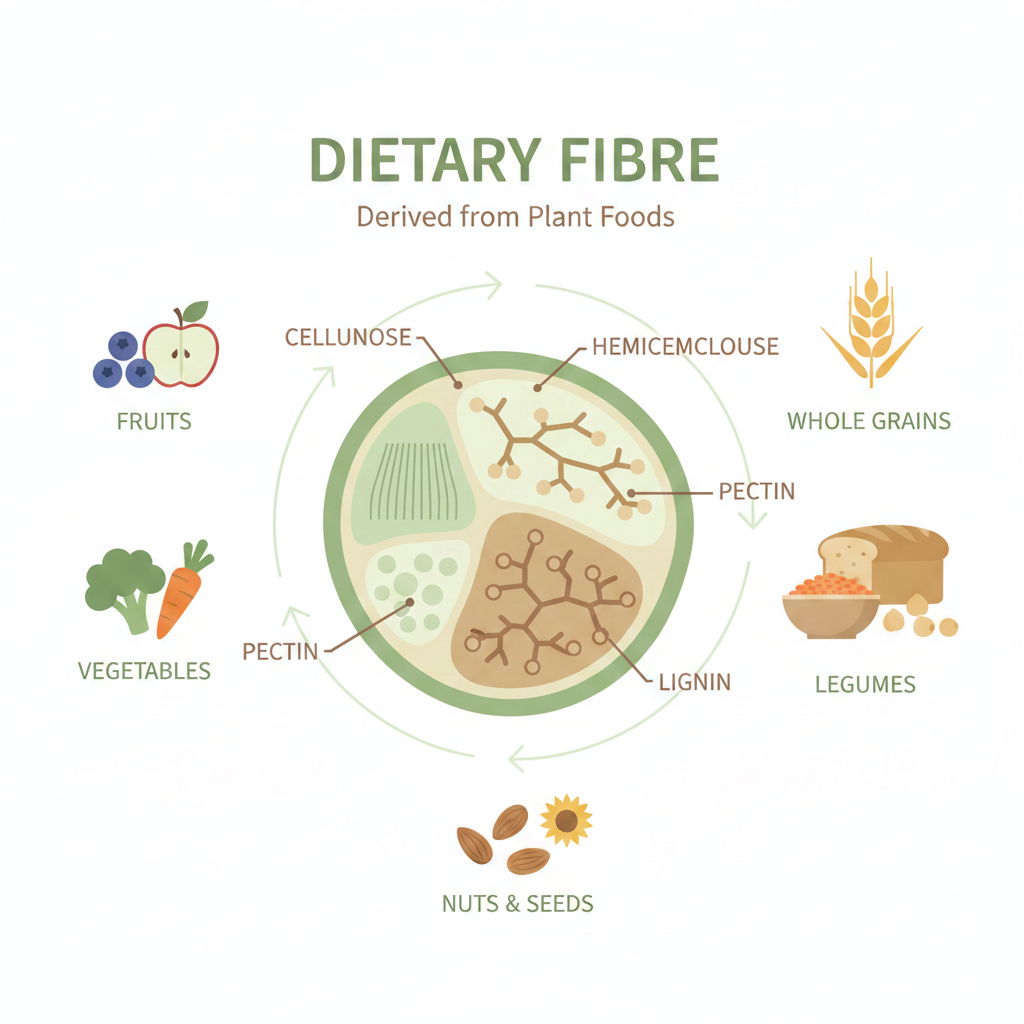
Fibre – IDietary fibre is defined as that portion of food derived from plant cells which is resistant to hydrolysis/digestion by the elementary enzyme system in human beings. It consists of hemicelluloses, cellulose, lignins, oligosaccharides, pectins, gums and waxes. Some bacteria in the large intestine can degrade some components of fibre, releasing products that can be absorbed into the body and used as an energy source.
Crude fibre is defined as the residue remaining after treatment with hot sulphuric acid, alkali and alcohol. The major component of crude fibre is a polysaccharide called cellulose. Crude fibre is a component of dietary fibre. Several other carbohydrates and related compounds called pectins, hemicelluloses and lignins are found in plant foods and are also resistant to digestion. These together with cellulose are collectively known as dietary fibre.
Insoluble fibres are indigestible and insoluble in water. Soluble fibres are indigestible but soluble in water. Total fibre is the sum of insoluble and soluble fibres.
Functional fibre is isolated, extracted from natural sources or synthetic fibre that has proven health benefits. Resistant starch functions as dietary fibre. Legumes are the primary source of resistant starch, with as much as 35 per cent of starch escaping digestion.
Functional fibre sources have shown to have similar health benefits as dietary fibre but are isolated or extracted from natural sources or synthetic. An example is pectin extracted from citrus peel and used as a food ingredient.
Total dietary fibre (TDF) is made of complex and heterogeneous polymeric materials such as soluble and insoluble polymeric materials such as soluble and insoluble polysaccharides as well as a range of non-swelling, more or less hydrophobic compounds such as cutins, suberins and lignins.
Total fibre = Dietary fibre + Functional fibre
Components
Chemically, dietary fibre is a polysaccharide whose basic units are neutral sugars such as glucose, mannose, xylose, arabinose and their derivatives or galacturonic acid. Lignin is a complex material composed of phenolic derivatives.
Table 4.1 gives details about fibre, its occurrence, chemical nature and sources.
Fibre – Its Occurrence, Chemical Nature and Sources
Insoluble Fibre
Cellulose
Occurrence: Cell wall constituent
Chemical nature:
Cellulose is a polysaccharide made up of glucose. β-glucose units are linked by 1,4 linkage. Due to difference in the chemical structure, cellulose is not acted upon by amylase present in the digestive juices. Cellulose is poorly fermented.
Sources:
Whole wheat, bran, root vegetables, legumes, peas, covering of seeds.
Hemicellulose
Occurrence: Secretions, cell wall material
Chemical nature:
Hemicelluloses are polysaccharides containing pentoses, hexoses and uronic acids. They are hydrolysed by hot dilute acids but are not acted upon by the digestive juices. Fermentability by intestinal microflora is influenced by structure and type of sugar.
Sources:
Bran, whole grains.
Lignin
Occurrence: Woody part of plants
Chemical nature:
Part of the plant cell wall and contributes to the structural rigidity of plants. It is thought to be responsible for the resistance of cell wall to microbial degradation. Insoluble in water and is not digested by colonic bacteria.
Sources:
Mature root vegetables such as carrot, with edible seeds, strawberries.
Soluble Fibre
Pectins
Occurrence: Intracellular cementing material
Chemical nature:
Pectins are compounds formed by the combination of a large number of galacturonic acids—anhydro-galacturonide residues, part of the carboxyl group existing as methyl esters. On hydrolysis, pectin yields mainly galacturonic acid and small amounts of galactose and arabinose. Pectins are water-soluble and in the presence of sucrose and citric acid, pectin forms a gel. Completely metabolised by colonic bacteria.
Sources:
Apples, citrus fruits, strawberries.
Gums
Occurrence:
Secreted at the site of plant injury by specialised secretory cells and can be exuded from plants.
Chemical nature:
Gums are composed of a variety of sugars and sugar derivatives. They contain sugars like galactose and glucuronic acid as well as uronic acids, arabinose etc. Gums are highly fermented by colonic bacteria.
Sources:
Gum arabic, oats, barley, legumes.
Note: Hemicelluloses that contain acids in their chains are slightly charged and water soluble.
PHYSIOLOGICAL AND METABOLIC EFFECTS
The effect of fibre on the gastro intestinal tract is influenced by the characteristics of the fibre itself, the particle size, the interaction between fibre and other dietary components and bacterial flora.
Effect on Nutrients
Nutrient absorption:
Dietary fibre is susceptible to physical disintegration during processing, cooking and mastication into fine particles. Consequent size reduction and dispersal of soluble fibre like β-glucans and pectins in the aqueous phase appears to be causing a delay in the uptake of absorbable nutrients by the epithelial cells that line the mucosa. Delay in absorption can lead to eventual excretion of nutrients.
Barrier to digestion:
Inspite of adequate processing, cooking and mastication, a part of the structure enveloping the nutrients remains intact and slows down the whole process of digestion and acts as a physical barrier between nutrients and digestive enzymes in the intestine. Legume seeds have relatively thick walls resisting breakdown during processing and cooking, and therefore, legumes constitute one of the lowest glycaemic response foods, that is, reduced rate of absorption of glucose.
Nutrient binding:
Many cell wall polysaccharides and lignins interact with metal ions—iron, calcium and zinc in the aqueous phase of the intestinal contents. This can result in conversion of soluble minerals into unabsorbable forms to be excreted. On the other hand carraginan, agar and guar gum, major sources of soluble fibre, interfere with absorption of Ca, Fe and Zn in rats. Diets with high levels of legumes, oats and whole wheat have undesirable effects on mineral absorption. This is due to the presence of polysaccharides and phytic substances present in these sources. Exogenous calcium binds at higher pH levels.
Table 4.2: Influence of Dietary Fibre on Gastrointestinal Tract
Site — Activity
Mouth: Stimulates saliva secretion.
Stomach: Dilutes contents, delays gastric emptying.
Small intestine: Dilutes contents, delays absorption.
Large intestine: Dilutes contents, forms substrate for bacteria, traps water, binds cations, softens stool, prevents straining.
Water-holding Capacity and Viscosity
Some water-soluble fibres such as pectins, gums and hemicelluloses have a high water-holding capacity and form viscous solution within the gastro intestinal tract.
Water-holding capacity depends on solubility, pH of the gastro intestinal tract, size of the fibre particles and degree of processing of foods. Coarsely ground bran has a higher hydration capacity than that which is finely
Delayed gastric emptying:
When fibres form viscous gels or hydrate within the stomach, the release of the chyme from the stomach into the duodenum is delayed. Thus nutrients remain in the stomach longer and slows down the digestion process, because carbohydrates and lipids remain in the stomach undergo no digestion and create a feeling of post prandial satiety.
Figure 4a: Gastrointestinal response to soluble and insoluble fibre
Soluble fibres
Nutrient adsorption or binding
Bile acid → ↑ Faecal bile acids
Lipid → ↓ Lipid absorption → ↓ Serum cholesterol
Mineral → Altered mineral balance
Gel formation
↓ Nutrient absorption
↓ Digestive functions
↑ Transit time
↓ Gastric emptying
↓ Nutrient absorption – glucose
↑ Water-holding capacity → ↑ Faecal volume
↓ Colonic transit time
↑ Frequency of defecation
Insoluble fibres
Degradability / fermentability
Lactate → Luminal acidification → ↓ bile acid synthesis
Short chain fatty acids
↑ Colonic sodium + water absorption
Energy
Inhibit tumour formation
Mucosal cell proliferation
Source: Groff L James and Sareen S Gropper, 1999, Advanced Nutrition and Human Metabolism, Wordsworth Thomson Learning, United States.
Reduced mixing:
The presence of viscous gels in the gastrointestinal tract can impair the ability of the nutrients in the food to interact with the digestive enzymes.
Reduced enzyme function:
Viscous gel-forming fibres interfere with enzymatic hydrolysis. Hydrocolloids may inhibit intestinal peptidases and pancreatic lipase. Fibre directly may decrease the activity of these enzymes or acts by reducing the rate of enzyme penetration into the food.
Decreased nutrient diffusion rate:
Nutrients to be absorbed, must move from the lumen of small intestine through a glycoprotein (mucin) rich water layer lying on top of the enterocytes. The hydrated fibre gel increases thickness of water layer ground.
and decreases rate of diffusion of nutrients and consequently maximal absorption is reduced.
Altered small intestine transit time:
Soluble fibres with decreased diffusion rates, with increased transit time may result in decreased nutrient absorption. This is due to insufficient time for the nutrients to be in contact with enterocytes.
After ingesting food, it takes about 4–12 hrs for the undigested portion to reach the colon. Complex plant foods not disrupted adequately, take longer time to pass through the stomach and small intestine. Soluble fibres with the viscosity increasing property slow down passage and delay gastric emptying. A high intake of dietary fibre generally causes reduced transit time in the colon and faster bowel emptying. This is attributed to accelerated colonic mobility by increased intraluminal mass. Higher the faecal bulk, lower will be the transit time in the large intestine.
Adsorption or Binding Capacity
Lignins, gums, pectins and hemicelluloses have the ability to bind substances such as enzymes and nutrients in the gastrointestinal tract. The ability of these fibres to adsorb substances depends in part on gastrointestinal pH, particle size, food processing and fermentability.
Mucilaginous fibres such as guar gum, pectin and psyllium delay glucose absorption, lower blood glucose concentration and affect hormonal response to the absorbed nutrient. Such effects reduce post prandial blood glucose concentration and insulin needs and are beneficial for diabetic patients.
Diminished absorption of lipids:
Soluble and insoluble fibres may affect lipid absorption by adsorbing fatty acids, cholesterol and/or bile acids within the digestive tract. Fatty acids and cholesterol that are bound to fibre cannot form micelles and cannot be absorbed in this bound form. Fibre bound lipids are typically not absorbed in the small intestine and pass into the large intestine, where they will be excreted in the faeces or degraded by intestinal bacteria.
Increased fecal bile acid excretion:
Adsorption of bile acids to fibres prevents the use of bile acids for micelle formation. And like fibre bound fatty acids, bile acids bound to fibre cannot be reabsorbed and recirculated and excreted or undergo colonic microflora degradation.
Lowered serum cholesterol concentration:
(a) With the excretion of bile acids in the faeces, less bile undergoes enterohepatic recirculation. Cholesterol is used for the synthesis of new bile acids. The net effect is lower serum cholesterol.
(b) Fibre shifts the bile acid pools away from cholic acid and toward chenodeoxycholic acid. Chenodeoxycholic acid appears to inhibit 3-hydroxy 3-methyl glutaryl CoA reductase, a regulatory enzyme necessary for cholesterol biosynthesis. Decreased HMG CoA reductase activity results in reduced hepatic cholesterol synthesis and lower blood cholesterol concentrations.
(c) Animal studies have suggested that production of propionate from bacterial degradation of fibre lowers serum cholesterol concentrations.
Psyllium, guar gum, oat and pectin lower serum cholesterol. Oat and soybean fibres have intermediate effects, while corn, wheat and rice bran appear to be ineffective. Fruits and vegetables decrease serum cholesterol concentration.
Altered mineral balance: The overall effect that fibre has on mineral balance depends to some extent on its degree of fermentability or its accessibility to enzymes in the colon. Microbial proliferation from slowly fermentable fibres result in increased binding of minerals within the new microbial cells and hence in the loss of minerals from the body assuming colonic mineral absorption is limited. Rapidly fermentable fibres such as pectins appear to have a favourable mineral balance. Calcium, zinc and iron bound to these fibre components are released as fermentation occurs and may possibly be absorbed in the colon.
Degradability or Fermentability
Fermentable fibres
Pectins, gums, oat and wheat bran and psyllium, which is mostly mucilages polysaccharides are degraded to short chain fatty acids. The short chain fatty acids released are primarily acetic, butyric and propionic acids. These acids are source of energy by colonic cells and by the liver. In addition to these acids products of fibre fermentation are hydrogen, carbon dioxide and methane gas which are excreted as flatus or are expired by the lungs.
The caloric content of inulin is 1 kcal/g. Inulin which is present in chicory is a polymer of fruit sugar fructose, a polyfructoside. Inulin is a soluble dietary fibre. Inulin is fermented by the bacteria and is called prebiotic as it stimulates growth of health promoting bacteria like lactobacilli and bifidobacteria. These symbiotic microbes colonise large bowels at the expense of harmful one such as coliform.
Increased water and sodium absorption in the colon: Short chain fatty acids produced by fermentation are rapidly absorbed and their absorption in turn stimulates water and sodium absorption in the colon.
Carbohydrates – Part II Dietary Fibre
Highlights
Fermentable fibre gives energy 2.6 kcal/g.
Dietary fibre gives energy 2.0 kcal/g.
Mucosal cell proliferation: Substrates from the degradation of dietary fibre in the colon stimulate the proliferation of mucosal cells in the gastrointestinal tract.
Provision of energy: Fermentation of carbohydrates by colonic anaerobic bacteria makes available to the body, some of the energy contained in undigested food reaching the caecum. More than 15 per cent of ingested carbohydrate may be fermented.
Acidification of luminal environment: Short chain fatty acids in the colon from bacterial fermentation of carbohydrate results in a decrease in the pH of the colon’s luminal environment. With the more acidic pH free bile acids become less soluble. Furthermore, the activity of 7 α dehydroxylase diminishes and thus decreases the conversion of primary bile acids to secondary bile acids. With the lower pH, calcium also becomes more available (soluble) to bind bile and fatty acids. These latter two changes may be protective against colon cancer.
Non-fermentable fibres
Cellulose and lignin are nonfermentable fibres. Along with slowly fermentable fibres such as hemicelluloses they are particularly valuable in promoting the proliferation of microbes in the colon. Microbial proliferation may be important for both detoxification as well as a means of increasing fecal volume. No energy is released from nonfermentable fibres.
Detoxification: Synthesis of increased microbial cells could result in the increased microbial scavenging and sequestering of substances or toxins, which eventually are excreted. Certain colonic bacteria appear to inhibit proliferation of tumour cells and/or delay tumour formation. Bacteria such as L. acidophilus reduced the activity of enzymes that catalyse the conversion of procarcinogens to carcinogens.
Increased faecal volume: Microbial proliferation may promote increased faecal bulk. Faecal bulk consists of unfermented fibre, salts and water as well as bacterial mass. Faecal bulk increases as fibre fermentability decreases. Dietary fibre increases faecal bulk and frequency of defaecation. Wheat bran due to its high insoluble fibre content and presence of highly lignified tissues, resist colon fermentation, thus increasing the dry matter content of faeces. Besides that, ability to retain water during transit contributes to soft stools and ease of defaecation. Processing and cooking Reduce the bulking effect due to physical disruption of the fiber structure. Cooking is little effective in increasing bulk and making defaecation easier but fine bran is ineffective.
The faecal weight on western diet is 80–160 g/day. Whereas Indian diet gives rise to 225 g/day of faeces. When dietary fibre is supplemented, weight can rise to 470 g/day.
Wheat bran is one of the most effective fibre laxative because it can absorb water, thereby producing a bulky stool. Gastrointestinal transit time is shortened.
Effects similar to wheat bran and rice bran include
decreased intraluminal pressure
ROLE OF FIBRE IN PREVENTION OF DISEASES
Coronary Heart Disease
High fibre in the diet reduces cholesterol. Pectin (apples, guavas) lowers the serum cholesterol and enhances the excretion of faecal steroids. It has no effect on serum triglycerides and HDL cholesterol. Guargum (extracted from seeds of cluster beans) has hypocholesterolaemic effect. Legumes, vegetables and fruits can lower the level of serum cholesterol, but the effect is usually small compared with drugs known effect on HDL and serum triglycerides. Psyllium which contains soluble fibre reduces cholesterol.
Studies show that blood pressure can be reduced by using fibre rich diet. Fibre also reduces serum fibrinogen levels, which in turn lower the risk of blood clot formation and myocardial infarction.
Oat products and barley contain high amount β-glucan content having hypocholesterolaemic effect. One of the postulations is that cholesterol synthesis is inhibited by acetic, propionic and butyric acids generated by the colon bacteria concurrent clearance of LDL cholesterol.
Fenugreek seeds are rich in fat, protein and fibre. Fenugreek seeds contain 25 per cent mucilaginous fibre and 50 per cent total fibre. The mechanism of hypocholesterolaemic effect of fenugreek seeds is same as that of rice bran. Incorporation of fibre in the diet brings about reduction in serum cholesterol by preventing its absorption. Seven per cent of total energy from fat, 59 per cent carbohydrate and 55
Carbohydrates – Part II Dietary Fibre
Fibre/2500 calories produce most favourable lipid profile.
Soluble viscous fibres are hypocholesterolemic reducing serum cholesterol by about 5–10 per cent for a 5–10 g dose in subjects with hypercholesterolemia whereas insoluble fibres do not show this effect.
Apples contain pectin which is a soluble fibre. They give feeling of fullness when eaten, binds to sugars, releasing them slowly and keeping the blood sugar and GI levels steady and lower cholesterol.
Diabetes Mellitus
Dietary fibre and complex carbohydrates both benefit type I and type II diabetics. Such diets lower insulin requirements and increase peripheral tissue insulin sensitivity.
Soluble fibres such as pectin, gums, hemicellulose (in fruits) increase intestinal transit time, delay gastric emptying, slow glucose absorption and lower serum cholesterol. At least 20–30 g of soluble fibre should be taken.
Insoluble fibre such as cellulose and lignin (vegetables, grains) decrease intestinal transit time, increase faecal bulk, delay glucose absorption and slow starch hydrolysis.
Diets high in carbohydrate and fibre improve glucose metabolism without increasing insulin secretion. They lower fasting serum and peripheral insulin concentrations in response to oral glucose administration in both diabetic and non-diabetic individuals.
Regular consumption of maize based foods had significantly lowering effect on levels of glycosylated haemoglobin although they were not low in glycaemic inde
increased faecal bulk
greater frequency of defaecation
reduced intestinal transit time