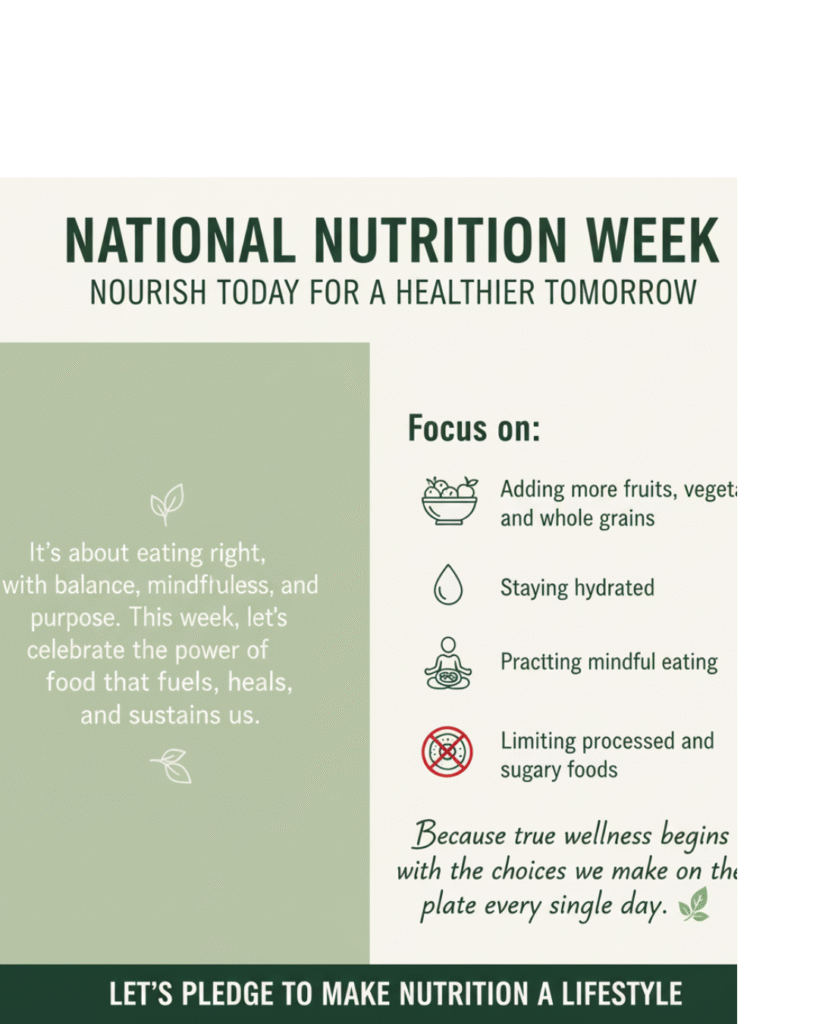
Each year, from 1st to 7th September, India commemorates National Nutrition Week—a seminal public health initiative instituted by the Ministry of Women and Child Development to illuminate the indispensable role of nutrition in fostering human potential and societal advancement.
This observance, far from being a perfunctory ritual, epitomizes a national introspection into the quality, consciousness, and adequacy of dietary practices. It underscores that nutrition is not a peripheral health concern but the fundamental axis upon which human longevity, productivity, and cognitive equilibrium revolve.
In an era defined by mechanized consumption, erratic lifestyles, and the seductive proliferation of processed foods, National Nutrition Week serves as an intellectual reminder that nourishment must transcend appetite—it must become an act of awareness, science, and self-respect.
Historical Context and Foundational Vision
National Nutrition Week was inaugurated in 1982 with the explicit intent of combating the dual menace of malnutrition and diet-related degenerative diseases. Over the decades, it has evolved into an interdisciplinary platform advocating nutritional literacy, preventive healthcare, and evidence-based dietary reform.
Each annual observance introduces a thematic emphasis—ranging from maternal nutrition to sustainable diets—inviting both public participation and professional engagement. Yet, its enduring purpose remains singular: to anchor national health policy in the bedrock of optimal nutrition.
India’s Nutritional Paradox
The Indian subcontinent today contends with a paradoxical burden—undernutrition and overnutrition coexisting within the same population. On one hand, vast sections continue to suffer from micronutrient deficiencies, stunted growth, and anaemia; on the other, urban populations grapple with obesity, insulin resistance, and metabolic disorders precipitated by overconsumption and dietary indiscretion.
This dichotomy exposes not merely a dietary imbalance but a crisis of awareness—a collective failure to recognize that quantity cannot substitute quality and that food, however abundant, must still nourish the body at a cellular level.
The Science of Balanced Nutrition
Nutrition is a biological symphony—a dynamic interplay of macronutrients (carbohydrates, proteins, fats) and micronutrients (vitamins, minerals, and phytonutrients) that collectively sustain life. It is not a singular act of eating but an ongoing biochemical conversation between food and physiology.
When this dialogue is harmonious, the body flourishes: immunity strengthens, cognition sharpens, and metabolism stabilizes. Conversely, nutritional neglect—be it through deficiency or excess—disrupts homeostasis and accelerates degenerative decline.
Thus, the pursuit of nutrition must be guided not by transient trends but by scientific discernment, moderation, and mindfulness.
Principles Underpinning Optimal Nutrition
1. Primacy of Whole and Unprocessed Foods
Nature, in its unaltered form, remains the most sophisticated provider of nourishment. Whole grains, pulses, seasonal fruits, vegetables, nuts, and seeds deliver a complex matrix of fibers, enzymes, and antioxidants that no laboratory synthesis can replicate.
2. Equilibrium and Moderation
Health resides in balance rather than extremity. The ideal diet accommodates diversity—permitting pleasure while preserving restraint. Moderation is, indeed, the highest form of nutritional intelligence.
3. Hydration: The Overlooked Nutrient
Water, though seldom glorified, is a physiological necessity. It governs thermoregulation, circulation, detoxification, and cellular communication. Chronic dehydration undermines all other dietary efforts, making hydration an elemental pillar of nutrition.
4. Mindful Consumption
The consciousness with which one eats directly influences assimilation. Distraction dulls digestion; awareness enhances absorption. Mindful eating reinstates dignity into dining—transforming a habitual act into a restorative ritual.
5. Adaptability Across Life Stages
Nutritional needs evolve through infancy, adolescence, gestation, and senescence. A truly informed dietary approach is one that acknowledges temporal and physiological transitions, ensuring that nourishment remains individualized, not generalized.
The Role of Nutrition Professionals and Public Policy
Dietitians, clinical nutritionists, and public health experts serve as the custodians of nutritional integrity. Their role extends beyond prescription—it encompasses education, advocacy, and behavioral transformation.
Governmental frameworks such as the Poshan Abhiyaan reflect this ethos, emphasizing maternal and child health, fortified supplementation, and community-based awareness. However, institutional efforts can achieve permanence only when mirrored by personal responsibility and domestic practice.
The true measure of National Nutrition Week lies not in campaigns but in habitual reformation—when nutrition becomes culture, not compulsion.
Conclusion
National Nutrition Week stands as an intellectual and ethical invocation—a call to reinstate nutrition to its rightful pedestal as the essence of vitality and the genesis of well-being.
Health, in its truest definition, is not the absence of disease but the presence of internal harmony—a balance sustained by disciplined nourishment, emotional poise, and conscious living.
As India advances toward holistic development, the narrative of progress must be underwritten by nutritional literacy and dietary integrity. For a nation’s strength is not measured solely in its economy or technology, but in the resilience, cognition, and vigor of its people—and that, ultimately, begins with food.