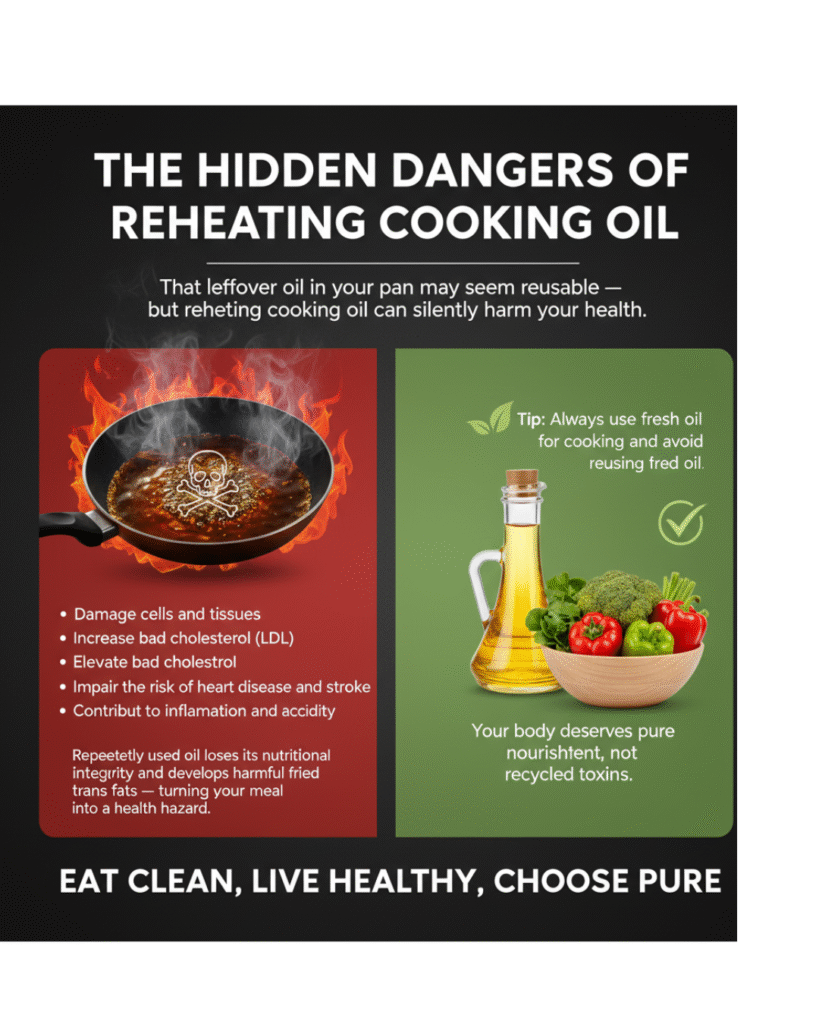
In the modern culinary milieu, the practice of reheating cooking oil has insidiously woven itself into domestic and commercial kitchens under the guise of convenience and thrift. Yet, beneath this veneer of practicality lies a grave biochemical hazard—the progressive degradation of lipids into noxious compounds that imperil human health.
What begins as a benign medium for cooking undergoes, upon repeated thermal exposure, an irreversible transformation: a nutritive substance devolves into a toxicant, undermining metabolic equilibrium, hepatic function, and cardiovascular integrity.
The Biochemical Deterioration of Oils
Cooking oils, especially those rich in polyunsaturated fatty acids, are inherently susceptible to oxidative, hydrolytic, and polymeric degradation when subjected to elevated temperatures. Upon reheating, these reactions intensify exponentially, producing free radicals, trans isomers, aldehydes, and polar compounds, each endowed with cytotoxic and mutagenic potential.
The smoke point—an indicator of oxidative stability—declines with every cycle of reheating, resulting in the formation of volatile aldehydes such as acrolein, a substance long recognized for its respiratory irritant and carcinogenic properties.
1. Formation of Carcinogenic and Mutagenic Compounds
Reheated oils serve as fertile grounds for the generation of polycyclic aromatic hydrocarbons (PAHs) and oxidized triglycerides, both of which possess carcinogenic proclivities. The chronic ingestion of such degraded lipids has been empirically associated with hepatic dysfunction, DNA damage, and oncogenic transformation.
Studies in lipid chemistry reveal that the repetitive use of cooking oils, particularly those employed in deep-frying, can lead to an accumulation of thermally oxidized derivatives, which induce oxidative stress and potentiate carcinogenesis.
2. Escalation of Free Radical Pathophysiology
The reheating process instigates the autoxidation of unsaturated fatty acids, yielding an abundance of reactive oxygen species (ROS). These unstable molecules disrupt cellular membranes, denature proteins, and alter nucleic acid integrity.
Cumulatively, this biochemical assault manifests as systemic oxidative stress, a condition intricately linked to neurodegenerative diseases, metabolic syndrome, and premature cellular senescence.
3. Dysregulation of Lipid Metabolism
The ingestion of thermally decomposed oils adversely modulates lipid metabolism and serum lipoprotein profiles. It has been observed that such oils elevate low-density lipoprotein (LDL) concentrations, diminish high-density lipoprotein (HDL) activity, and impair vascular elasticity.
These pathophysiological shifts accelerate atherosclerotic progression, thereby heightening the propensity for hypertension, coronary artery disease, and cerebrovascular events.
4. Hepatotoxic and Gastrointestinal Sequelae
Reheated oils impose a considerable metabolic burden upon the liver, the principal organ of lipid metabolism. The detoxification of oxidized lipids and aldehydic compounds depletes hepatic antioxidant reserves, predisposing to fatty liver infiltration, enzymatic dysfunction, and hepatocellular stress.
Moreover, such oils irritate the gastrointestinal mucosa, impeding enzymatic digestion and impairing nutrient absorption—culminating in dyspeptic symptoms and chronic inflammatory states.
5. Erosion of Nutritional and Functional Integrity
The repeated heating of oils annihilates essential nutraceutical constituents, including tocopherols (vitamin E) and phytosterols, thereby obliterating their antioxidative and cardioprotective capacities. The resultant oil is devoid of its biological virtue and transformed into an inert, lipidic residue replete with pro-oxidant entities.
Thus, reheated oil ceases to be a vehicle of nourishment and becomes, instead, a vector of metabolic toxicity.
Preventive Strategies and Culinary Vigilance
To mitigate the deleterious consequences associated with oil reheating, certain precautionary measures are imperative:
- Abstain from reusing oils previously exposed to high temperatures or deep-frying conditions.
- Discard oil that exhibits darkening, viscosity, rancidity, or smoke formation.
- Employ oils of high oxidative stability, such as cold-pressed olive oil, mustard oil, or rice bran oil, within recommended temperature thresholds.
- Store oils appropriately, in airtight, opaque containers away from direct sunlight, to forestall premature oxidation.
- Adopt alternative cooking techniques—steaming, baking, or air-frying—that minimize lipid degradation and conserve nutrient quality.
Conclusion
The reheating of cooking oil epitomizes a silent dietary malpractice—a ritual of culinary convenience that surreptitiously compromises physiological integrity. From a biochemical perspective, it constitutes the conversion of nourishment into a vector of pathology, catalyzing oxidative damage and systemic inflammation.
True dietary discipline demands more than the selection of wholesome ingredients; it necessitates cognizance of their transformation under heat and time. To revere health is to exercise restraint—to regard oil not as a mere medium of flavour but as a sensitive biochemical entity deserving of respect and renewal.
In the art of nutrition, wisdom resides not merely in what one eats, but in how one chooses to prepare and preserve it.